



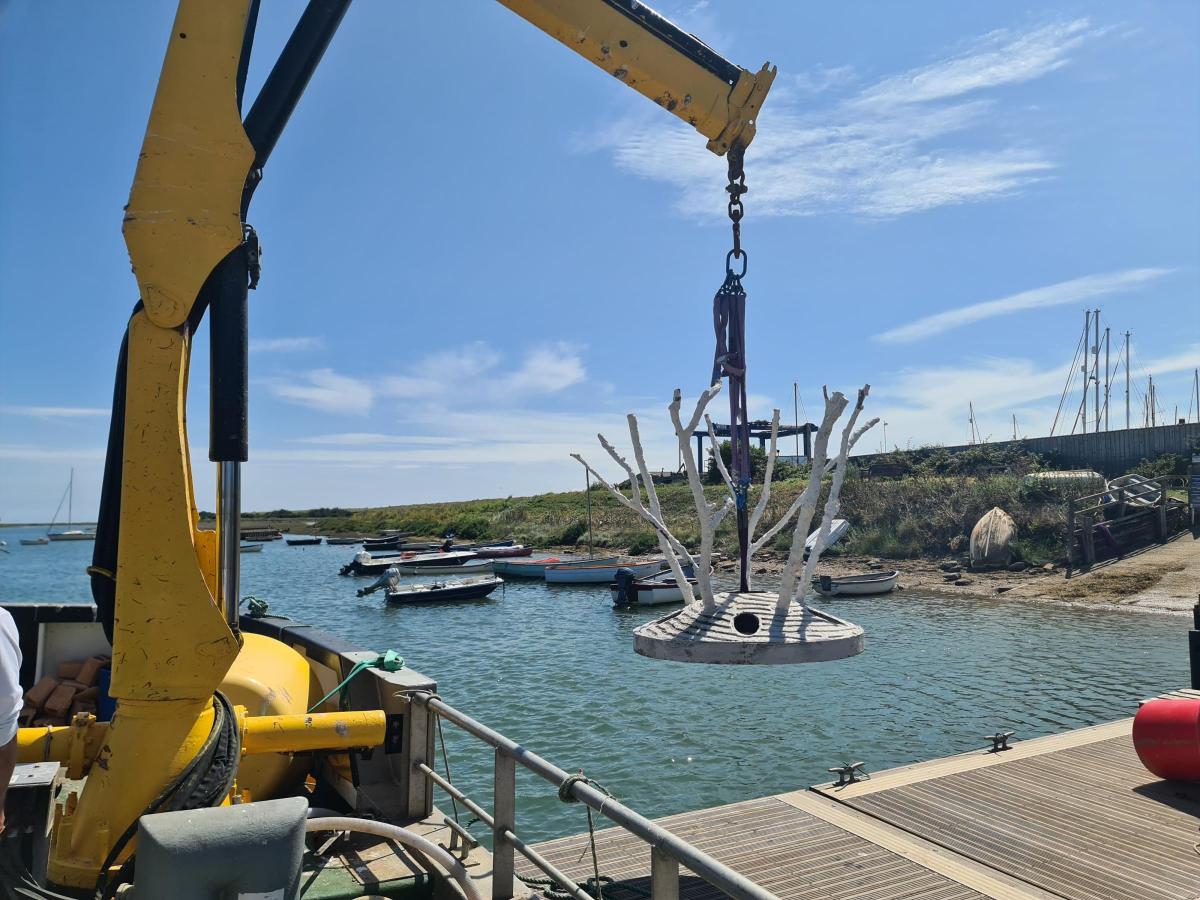


Native oyster reefs once played a significant role in the North Sea ecosystem, supporting marine life and improving water quality. Through its OysterForest project, Exo Engineering is recreating the conditions those habitats need to return.
For centuries, native oyster reefs formed an important part of the North Sea ecosystem. They filtered seawater, created habitat for countless marine species and helped bring structure
to otherwise featureless stretches of seabed.
Today, much of that habitat has disappeared. Native oyster populations in UK waters have declined significantly, leaving many areas of the North Sea without the reef systems that once supported a diverse range of marine life.
Exo Engineering is investigating how artificial reef structures could help native oysters regain a foothold in offshore environments.

“The OysterForest is designed to address the challenge of restoring biodiversity in the North Sea and other offshore environments,” said operations manager Jack Cattermole.
“Oysters are well known for their ability to filter water. They help remove suspended material such as silt and contribute to improving water quality.
“They also create self-sustaining reef systems. Once oysters become established, new oysters settle on existing shells, gradually building extensive reef structures over time.”
READ MORE: How Exo Engineering is building biodiversity into the seabed
The concept began when an offshore wind developer approached the company to investigate whether a new type of artificial reef could be developed.

Exo sought to design a system capable of addressing one of the key barriers to oyster recovery: the lack of suitable surfaces for settlement.
Jack and his team developed a biodiversity-enhanced prototype that first had to work within vessel lifting limits and transport restrictions.
Its nature-inclusive concrete base provides stability on the seabed while creating opportunities for colonisation by marine life, and wooden elements add habitat complexity.
Sam Greenhill, marine monitoring consultant at Exo Engineering, explained further: “Sunken branches and woody debris naturally create the kind of complex, textured surfaces that biofilms, invertebrates and fish are drawn to far more than concrete surfaces.”
Centuries ago, meandering rivers carried woody material down to estuaries and the sea. Today there is a chronic lack of it for marine life.
Rather than using virgin timber, the OysterForest project makes use of tree branches either from renewable forestry waste sources, or coppiced hardwood, harvested through traditional UK woodland management.
Exo Engineering worked with the University of Essex to investigate how different wood species perform in marine environments and how their chemical composition could influence settlement rates.
READ MORE: How artificial reefs support marine life in wind farms
Researchers analysed tannin concentrations and tested a range of materials through laboratory and field trials.
Sam said: “Through our OysterForest project research and development, it became clear that the tannin content of the wood may negatively affect oyster settlement.”
The team also explored lime-based coatings to make surfaces more attractive to settling oysters.
“Adding a lime-based coating can create a calcium-rich surface that mimics natural shell chemistry, essentially giving the branches a shell-like surface which the larvae find more attractive,” Sam said.
Researchers also trialled crushed oyster shell within the coating mix to improve settlement cues and increase surface texture.
“Beyond oysters, the OysterForest design will be attractive to a wide range of other marine species,” Sam added.

The branches create a naturally complex reef-like structure that can provide a nursery for juvenile fish of many species.
“We are now scaling this prototype to a 10 to 20 tonne solution that is easily deployed as an instant seabed feature around existing offshore infrastructure,” said managing director William Coulet. “The scaling up of this solution is critical to match offshore operations sized vessels, structures and requirements in relation to seabed stability.”
As offshore industries increasingly look for ways to support biodiversity alongside development, OysterForest represents Exo Engineering’s latest attempt to show how carefully designed infrastructure can help rebuild some of the habitats the North Sea has lost.
Exo Engineering joins CubeX Industries
Exo Engineering is merging with Basildon-based manufacturer CubeX Industries in a move that brings together nature-inclusive design expertise and specialist concrete engineering.
The partnership will combine Exo Engineering’s marine ecology and habitat restoration capabilities with CubeX’s experience manufacturing precast concrete products for marine and coastal environments.
The launch coincides with the creation of CubeX Environmental, a new division bringing together the Exo Engineering product range and CubeX’s existing environmental expertise.
William Coulet, managing director of Exo Engineering, said the merger would enhance the company’s offering.
“The fusion of Exo Engineering Int. Ltd into the CubeX brand is aimed at strengthening the services and products we offer,” William said. “It adds our specialist nature-inclusive designs and marine biology skillset to the specialist concrete engineering of CubeX.
“This will result in an optimised product offering in relation to sustainability, engineering and environmental enhancement. Clients will continue to receive the same high quality and project-focused service they’re used to.”
Charlie Phelines, managing director at CubeX, said the combination would allow the business to offer a broader range of products and services to developers looking to enhance biodiversity.
“From our factory, we produce engineered concrete elements built to perform in demanding conditions, using a specialist marine mix refined over many years,” Charlie said.
“Our sister business, BlueCube Marine, brings a track record of completed marine ecological projects, a library of over 30 moulds, extensive ecological documentation and case studies, and an established client base.
“We are excited to announce the launch of CubeX Environmental, a new division of CubeX that brings together BlueCube Marine and the Exo Engineering product range.
“Combining Exo Engineering’s ecological design expertise with our manufacturing capability, CubeX Environmental will offer clients a broader range of nature-enhancing products, from specification through to delivery.”
For more information, visit exo-engineering.co.uk
This story is also published in Insight Energy magazine, covering the latest news from the UK's energy sector. Read the latest edition here.


Share